
Nez Perce Scheduled Versus Actual Release
A scheduled, projected, eligible, and actual release date are not the same fact. A court sentence begins the legal calculation. A Parole Eligibility Date, or PED, marks the point when a state prisoner may be considered for parole after the fixed term. A Next Parole Hearing Date identifies a review event. COPP may issue a tentative parole date after a grant. Released to Supervision records a placement that has occurred. Sentence Satisfaction Date is IDOC's calculated endpoint for an active sentence.
For a county pretrial detainee, those state fields may not apply at all. Release may depend on bond, recognizance, dismissal, acquittal, a court order, resolution of a hold, or a later sentence. A local sentence is calculated from the court commitment and jail records. Federal sentenced prisoners use the separate BOP calculation.
Find Nez Perce Projected Release Dates
Start with the last known custodian. Applying an IDOC date to a county booking is a common error. The sheriff's current PDF has no release-date field, so detention staff and the court are the local route. State dates belong in IDOC and COPP records. BOP dates cover federal sentenced custody only.
- Identify whether the person is pretrial, county-sentenced, IDOC-sentenced, or federally sentenced.
- For county custody, check the court action and call Nez Perce detention at 208-799-3132. Ask which records route controls the calculation.
- For an Idaho prisoner, open the IDOC Resident/Client Search, match identity, and read the complete detail.
- Compare PED, Next Parole Hearing Date, Sentence Satisfaction Date, and any COPP tentative action without merging their meanings.
- After the expected date, confirm physical status with the custodian and retain the actual release or discharge record.
The broader county search workflow is available on the Nez Perce County released inmates home page. It explains why roster absence is not enough.
Nez Perce IDOC Date Labels
IDOC does not display a public field literally named “Projected Release Date” in the inspected record. Its exact labels matter. The results list shows identity and broad status. An active detail may show current physical location, offense row, sentencing county, Parole Eligibility Date, Next Parole Hearing Date, Released to Supervision, and Sentence Satisfaction Date. Not every person has every field.
The official IDOC date-field example demonstrates the PED, hearing, and sentence satisfaction labels.
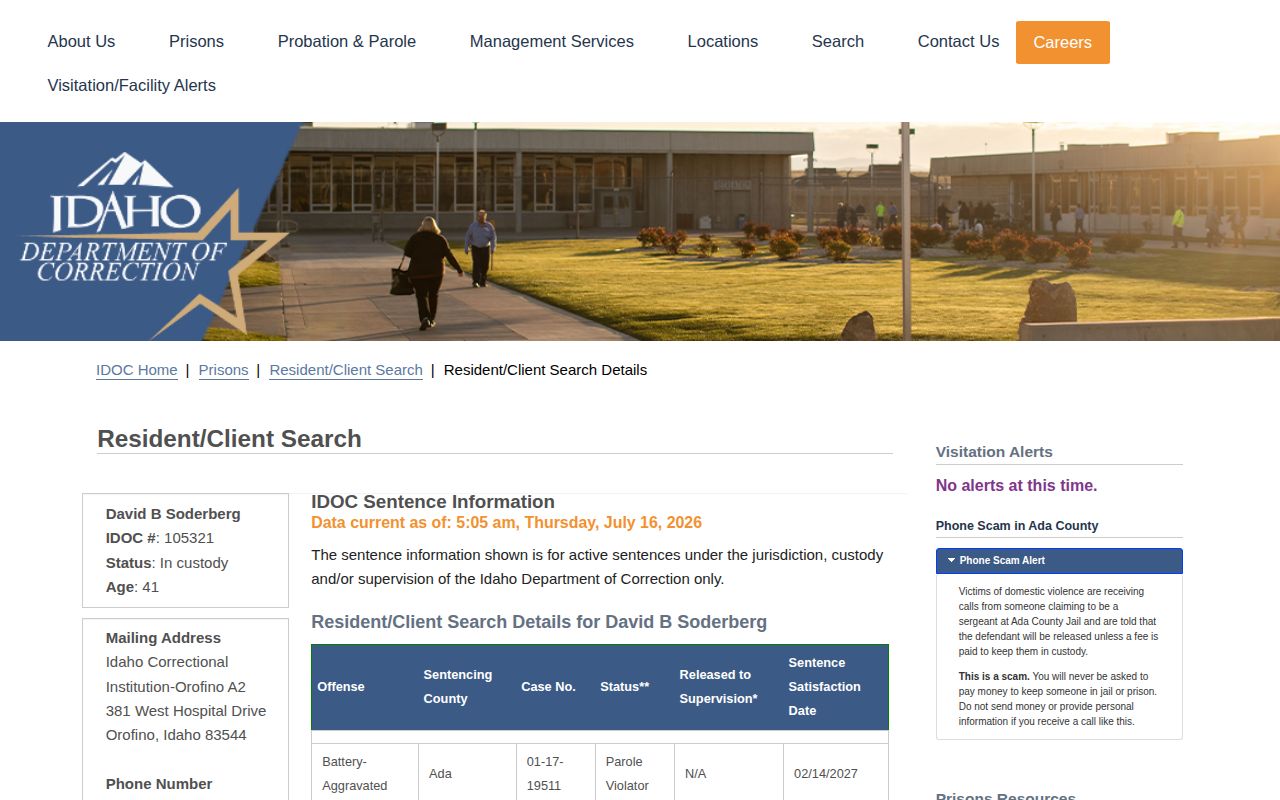
The image supports the date hierarchy, not a prediction about any other person. IDOC warns that daily data may not reflect the newest location, status, or scheduled termination information.
| IDOC field | What it answers |
|---|---|
| Parole Eligibility Date | When parole consideration may begin |
| Next Parole Hearing Date | When COPP plans a review |
| Tentative parole date | A conditional target after Commission action |
| Released to Supervision | A past community placement date |
| Sentence Satisfaction Date | The current calculated sentence endpoint |
| Discharged date | Historical proof the state sentence ended |
Nez Perce County Date Sources
The county jail, court, IDOC, COPP, and BOP each control a different record. Nez Perce detention controls present jail custody and the county exit record. The Second Judicial District court controls its judgment and release orders. IDOC controls state sentence calculations and prison status. COPP controls parole hearings and actions. BOP controls federal sentence calculations.
| Situation | First source | Confirmation |
|---|---|---|
| Pretrial county detainee | iCourt and detention | Jail release record |
| County jail sentence | Court commitment and detention | County calculation or release record |
| Idaho prison sentence | IDOC detail and COPP action | IDOC status or records response |
| Federal prison sentence | BOP locator | BOP record |
| Tribal case | Tribal Court or custodian | Tribal record under tribal rules |
A court order explains legal authority but not the precise door-out time. Likewise, leaving the county roster can mean transfer to IDOC, another jail, USMS, ICE, or a tribal authority. The physical custodian remains the best source for immediate status.
Idaho Release Date Calculation
Idaho's unified sentence has a fixed term and an indeterminate term under Idaho Code §19-2513. The fixed term is the minimum period of confinement before parole eligibility. Modern Idaho sentences do not use a routine rule that turns the sentence into an 85-percent calculation. That shortcut would misstate Idaho law.
Ordinary good time under §20-101A concerns offenses committed before July 1, 1986. For modern crimes, §20-101D permits only a narrow, exceptional meritorious reduction process. It is not an automatic monthly credit and should not be assumed for a named prisoner.
No published Nez Perce-specific county jail good-time formula was verified. For a local sentence, ask detention or records how the commitment, lawful credit, and holds were applied. Do not copy the state prison framework into the county calculation.
Nez Perce Weekend Parole Dates
Idaho has a distinctive weekend and holiday rule for a state prisoner's PED. Under Idaho Code §20-239A, COPP may set the parole date on the immediately preceding weekday when the PED falls on a weekend or legal holiday. The word “may” matters. The adjustment is discretionary, not an automatic promise of early release.
This rule concerns parole timing for an eligible state prisoner. It does not create a county jail release schedule, and it does not establish that a tentative date became an actual exit. The COPP action, IDOC detail, physical location, and later Released to Supervision field should be read together.
Note: No verified county-specific release hour, exit point, family waiting rule, or holiday processing schedule was found in the research sweep.
Why Nez Perce Dates Change
An expected date may move or fail to produce community release. The reason must come from the controlling record, not guesswork. Court papers may still need to reach and be processed by the custodian. Another warrant or detainer can hold the person. Consecutive sentences can extend custody. A transfer order can move the person without releasing them.
| Factor | Possible effect | Best record |
|---|---|---|
| Paper processing | Actual exit follows the order | Court and jail record |
| Warrant or detainer | Hold or transfer | Custodian and issuing authority |
| Consecutive sentence | Later endpoint | Judgment and IDOC calculation |
| Parole denial or rescission | Tentative date does not occur | COPP action |
| Required program or plan | Conditional target may move | COPP and IDOC |
| Lawful recalculation | Satisfaction date changes | IDOC records |
If sources conflict, record each timestamp. Prefer the physical custodian for present status, the court for its order, COPP for its decision, and IDOC for the state calculation.
Confirm Nez Perce Actual Release
After a projected date passes, check the full IDOC detail or call the local custodian. “In community” should be reconciled with physical location because a Nez Perce example showed community case status while the person was at the county jail. A “Discharged MM/DD/YYYY” result is strong proof that the identified state sentence ended, but it does not rule out a later case.
VINELink can send a pending custody-change notice, yet it may lag and does not cover every system. Its alert is a lead, not a release certificate. The registration process and county-coverage caveat are explained in the VINELink Check. For durable proof, request the actual county release record or the relevant IDOC public record.
Nez Perce Release Record Requests
A narrow records request can resolve a date that public interfaces do not show. For a county episode, give the sheriff the exact name, aliases, date of birth when lawfully known, booking number, and a short date range. Ask for admission, actual release time, disposition, and any public transfer destination. For a state sentence, send IDOC a separate request for the sentence calculation, housing or releasing facility, Released to Supervision, Sentence Satisfaction Date, and final discharge. COPP hearing minutes or actions must be requested from the Commission, not folded into a broad sheriff request.
Keep the response date and source with each result. A county record made after physical processing is stronger for the jail exit than an earlier court order. An IDOC calculation is stronger for the state endpoint than a county roster. When an agency grants only part of a record, ask for the statutory basis for each withheld part and for all nonexempt portions. This avoids turning a missing public field into a false claim that no date exists.
Save the original request, acknowledgment, extension notice, final response, and produced record together. If the calculated date later changes, that chain shows which agency supplied each value and when it was current. It also keeps a tentative Commission action separate from the later state release event.